


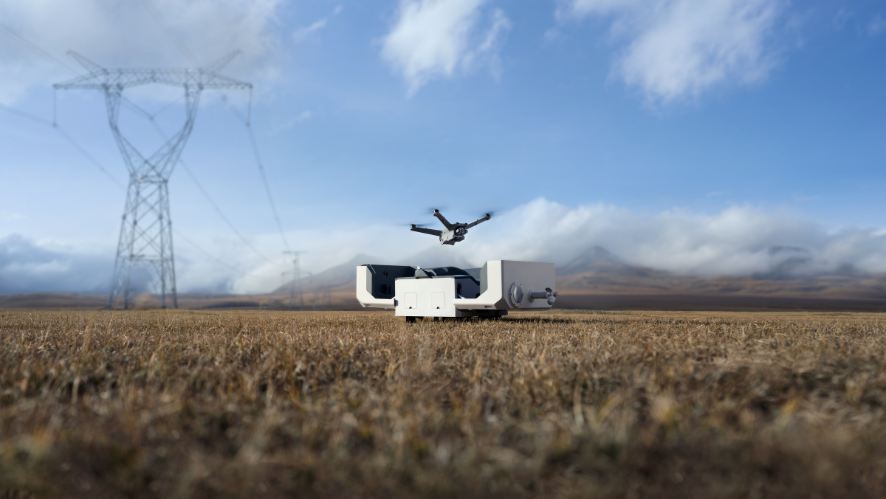
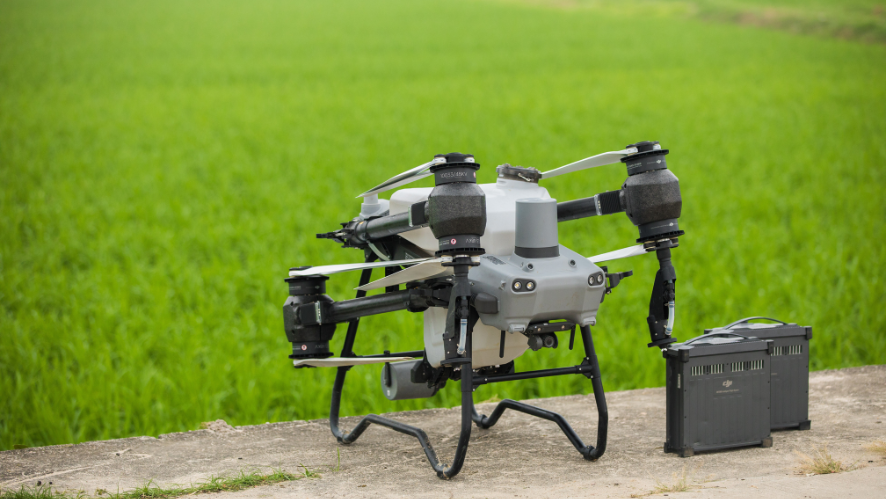
DJI has redefined the delivery drone market with the FlyCart series. The FlyCart 30 paved the way, proving the viability of heavy aerial transport. Now, with the launch of the FlyCart 100, the company is not only evolving but drastically expanding the boundaries of what is possible. This article analyzes the key differences between the two models, helping to understand which one best suits each logistical need.
Quick Comparison: FC30 vs. FC100
|
Feature
|
DJI FlyCart 30
|
DJI FlyCart 100
|
|
Max Payload (Dual Battery)
|
30 kg
|
85 kg
|
|
Max Payload (Single Battery)
|
40 kg
|
100 kg
|
|
Range (Max Payload, Dual Battery)
|
16 km (with 30 kg)
|
12 km (with 65 kg)
|
|
Range (No Load, Dual Battery)
|
28 km
|
26 km
|
|
Main Sensors
|
Phased Array Radars, Binocular Vision
|
High-precision LiDAR, Millimeter-Wave Radar, Penta-Vision System
|
|
Winch System
|
20 m cable, 0.8 m/s retraction
|
30 m cable, 1.2 m/s retraction
|
|
Fast Charging
|
N/A (C8000 Charger)
|
9 min (30% to 95%) with C12000 charger
|
|
Protection & Environment
|
IP55, -20° to 45° C, 12 m/s winds
|
IP55, -20° to 40° C, 12 m/s winds
|
In-Depth Analysis of Differences
While the table offers a summary, a deeper analysis reveals that the FlyCart 100 is more than just a larger version of the FC30. It represents a technological leap in critical areas such as performance, safety, and operational efficiency.
Payload Capacity and Performance: The Raw Power of the FC100
The most impactful difference between the two models is undoubtedly the payload capacity. The FlyCart 30, with its capacity of 30 kg (dual battery) to 40 kg (single battery), was already a robust tool for light logistics. It is ideal for transporting technical equipment, medical supplies, or medium-sized spare parts.
The FlyCart 100, on the other hand, takes the game to an industrial level. With a maximum capacity of 85 kg with dual batteries and an impressive 100 kg with a single battery, it more than doubles its predecessor’s capacity. This strength allows for the transport of loads that were previously unthinkable for drones, such as heavy industrial tools, multiple bags of seeds for agriculture, or components for power towers. This evolution is the result of an optimized design, 62-inch carbon fiber propellers, and higher-torque motors.
Both drones reach a maximum speed of 20 m/s (72 km/h) and can operate at altitudes of up to 6,000 meters (without load), making them suitable for mountainous terrain and challenging conditions.
Safety and Sensors: The Evolution of Perception
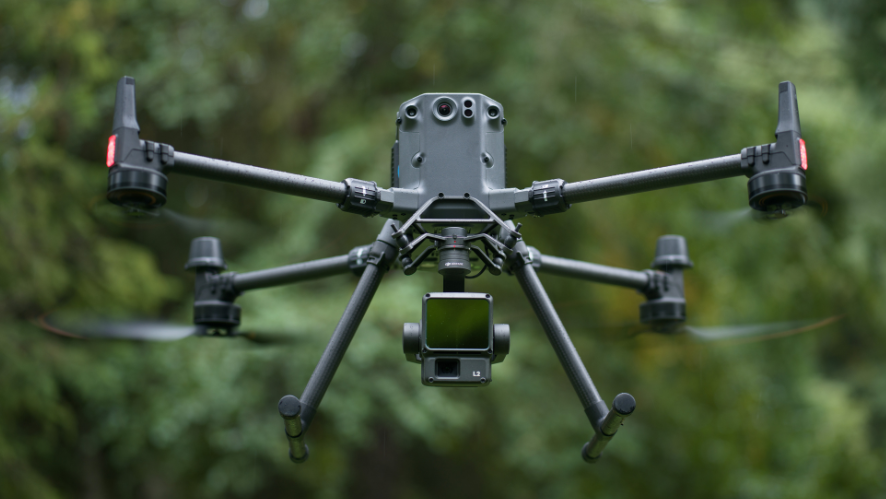
Safety is a fundamental pillar in cargo drone operations, and the FlyCart 100 introduces a visibly superior sensor system. The FlyCart 30 was already well-equipped, with front and rear Phased Array radars and a binocular vision system for multi-directional obstacle detection.
The FlyCart 100, however, integrates a state-of-the-art sensor suite, dubbed the “Intelligent Safety System,” which includes:
- High-precision LiDAR: Allows for terrain mapping and detection of thin obstacles, such as cables and tree branches, even at night or in low visibility.
- Millimeter-Wave Radar: Offers 360-degree detection, complementing LiDAR in adverse conditions such as fog or heavy rain.
- Penta-Vision System: A set of five cameras (four fisheye and one FPV) that provide complete situational awareness, feeding the obstacle avoidance algorithms.
This multimodal sensor combination gives the FC100 a much more robust environmental perception capability, crucial for operating safely in complex environments such as construction sites or dense forests.
Both models feature an integrated ballistic parachute, a vital safety feature. In the event of a critical failure, the parachute is deployed to ensure a controlled descent. However, the FC100’s system has been enhanced, with a minimum deployment altitude of 100 meters, compared to 60 meters for the FC30, reflecting the aircraft’s greater weight and inertia.
Operational Efficiency: Power and Autonomy
The ability to maintain continuous operation is a decisive factor in logistics. Here, the FlyCart 100 introduces two revolutionary improvements: ultra-fast charging and hot-swappable batteries.
With the DJI C12000 charger or the D14000iE generator, the FC100 batteries (model DB2160) can be charged from 30% to 95% in approximately 9 minutes. Additionally, the dual-battery design allows for hot-swapping, meaning operators can replace batteries without powering down the drone, minimizing downtime and allowing for near-continuous operations. The batteries also feature a self-heating system to ensure performance in cold climates down to -20°C.
The FlyCart 30, while efficient, uses a more conventional charging system with the C8000 charger and does not support hot-swapping, requiring more careful planning of battery cycles to maintain mission continuity.
Delivery Systems: Enhanced Winch and Cargo
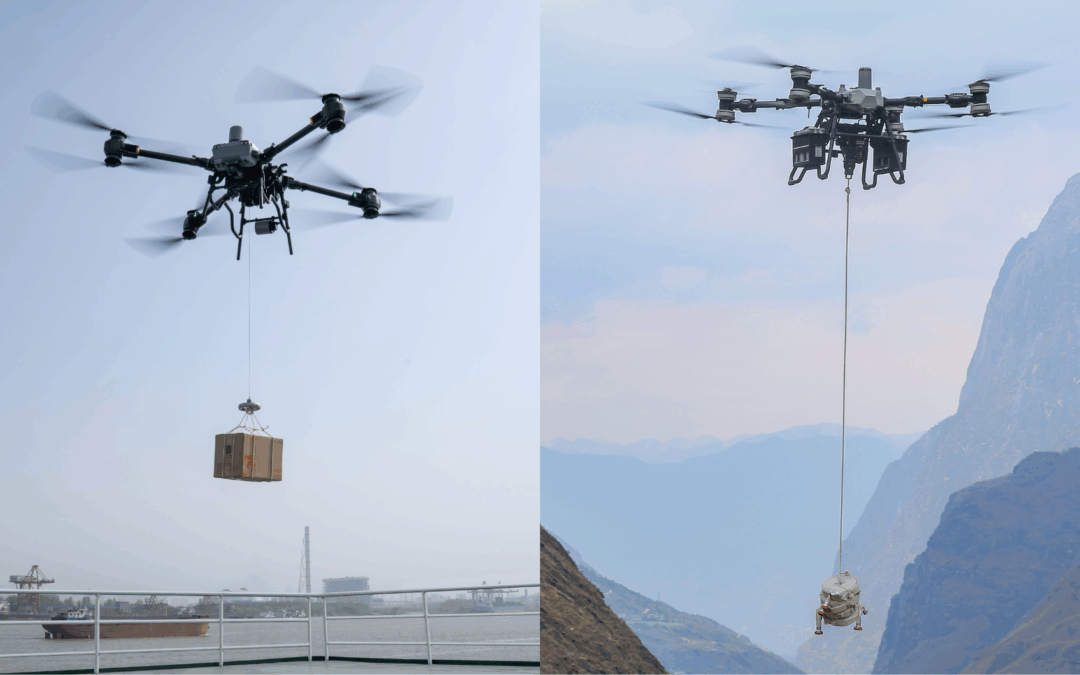
Both drones support two delivery modes: a cargo container (Cargo Mode) and a winch system (Winch Mode). The FlyCart 30 comes with a 70-liter box and an optional winch with a 20-meter cable and 0.8 m/s retraction speed, ideal for deliveries in locations without a safe landing spot.
The FlyCart 100 significantly improves the winch system, now called the “Flagship Winch System.” It features a longer 30-meter cable and a 50% faster retraction speed of 1.2 m/s. The system also includes an electric hook for more efficient loading and unloading and maintains the intelligent anti-sway feature to stabilize the load during flight. These improvements make winch deliveries faster and more versatile, especially in steep terrain or over water.
Practical Applications: Which Drone for Which Mission?
The choice between the FlyCart 30 and the FlyCart 100 depends entirely on the scale and nature of the operation.
DJI FlyCart 30 is the perfect tool for medium-sized logistics and specialized deliveries. Its ideal applications include:
- Medical deliveries: Rapid transport of medicines, vaccines, or organs between hospitals.
- Light emergency response: Delivery of radios, first aid kits, and food for rescue teams.
- Infrastructure maintenance: Carrying tools and spare parts to technicians in hard-to-reach locations.
- E-commerce and retail: Offering premium delivery services in urban and suburban areas.
DJI FlyCart 100 is designed for heavy industrial missions and large-scale logistics, where payload capacity is the critical factor. Its applications include:
- Construction and engineering: Transporting materials such as cement bags, small machinery, or structural parts to remote construction sites.
- Energy and utilities: Delivery of heavy components for offshore wind turbines or transmission towers in mountains.
- Mining and exploration: Transporting rock samples, drilling equipment, and supplies to isolated exploration sites.
- Humanitarian disaster relief: Mass delivery of water, food, and shelter to communities isolated by floods or landslides.
Conclusion: One Family, Two Scales of Operation
The DJI FlyCart 30 and FlyCart 100 are not competitors but rather complements in an expanding aerial logistics ecosystem. The FlyCart 30 set the standard for robust and reliable delivery drones, being an agile and efficient solution for a wide range of transport tasks.
The FlyCart 100, in turn, represents a quantum leap in capacity and technology. It does not replace the FC30 but opens a new range of possibilities for industries that depend on transporting extremely heavy loads in challenging environments. With its raw power, advanced sensors, and enhanced operational efficiency, the FC100 is truly an “aerial truck,” ready to transform industrial logistics as we know it.
_______________________________________________________