


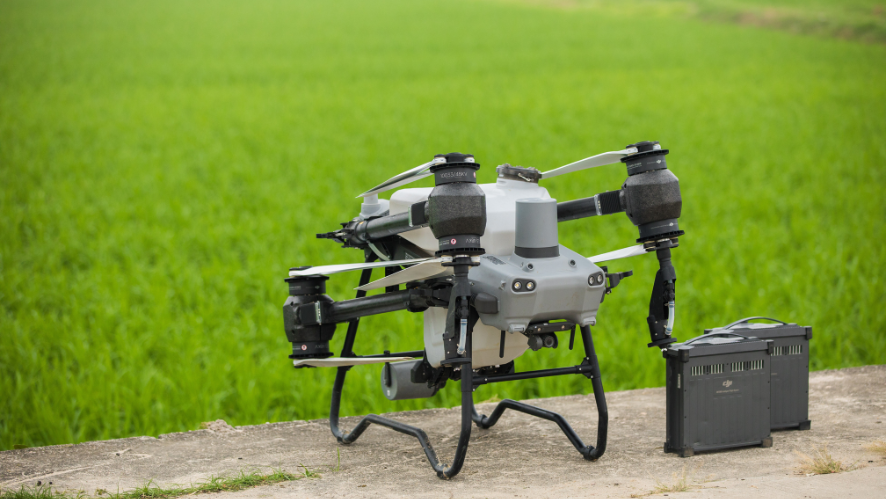
The industrial drone market has just taken a monumental leap forward with the launch of the DJI FlyCart 100 (FC100). This is not just another delivery drone, but a robust logistics platform designed to redefine the limits of air transport in sectors such as emergency rescue, construction, and energy. With impressive payload capacity and cutting-edge technologies, the FC100 goes far beyond what is expected of an unmanned aerial vehicle.
To understand the magnitude of this innovation, we have selected five interesting facts that demonstrate why the DJI FlyCart 100 is a true game changer.
1. Extreme load capacity: up to 100 kg Where no one else can reach
The first notable feature of the FC100 is its raw power. In an emergency configuration with a single battery, the drone is capable of carrying an impressive payload of 100 kg. This capacity is ideal for critical short-range missions where maximum weight is a priority.
However, for standard commercial operations, safety and autonomy are optimized with the use of two batteries. In this mode, the FC100 carries up to 85 kg, ensuring power redundancy and increasing its range. With a 65 kg payload, for example, it can travel a distance of up to 12 km. This flexibility allows operators to perfectly balance the relationship between weight, distance, and safety for each specific mission.
2. More than just a hook: a smart hook with an anti-slip system
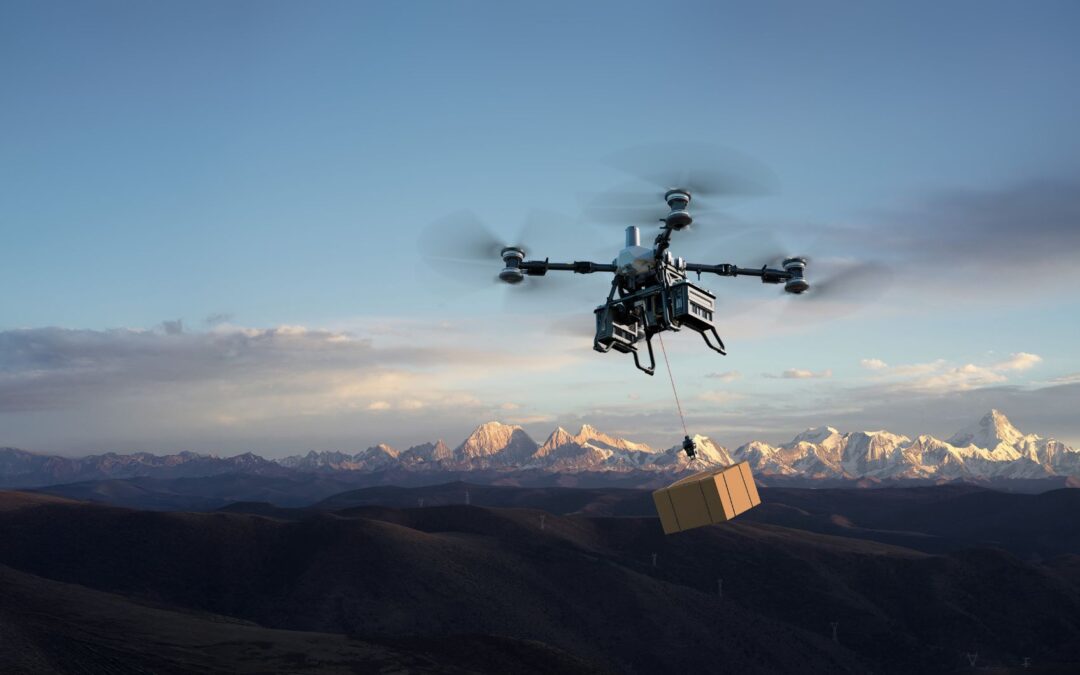
The DJI FlyCart 100 offers two transport systems: a standard cargo mode for deliveries with landing and a sophisticated winch system. It is in the latter that the technology really stands out. The winch has a 30-meter retractable cable that allows the drone to hover over hard-to-reach places, such as a ship’s deck, a clearing in the forest, or a construction site on uneven terrain, and lower the load with precision.
The big difference is the anti-sway technology, which uses flight control algorithms to actively reduce the pendulum effect of the load during transport, ensuring stable and safe delivery.
In addition, the system includes smart features that take automation and safety to the next level:
Auto-release hook: The electric hook can automatically release the load upon touching the ground, enabling contactless deliveries without the need for human intervention on site.
Emergency cable release: In an extreme situation where the load cable becomes jammed or entangled, the operator can activate a function to release the cable, ensuring the safety of the aircraft and allowing it to return to base.
3. Continuous operation: hot-swappable batteries and 9-minute recharge time
Operational efficiency is one of the biggest challenges in drone logistics. The FC100 addresses this issue with a power system designed to minimize downtime. The drone is powered by two DB2160 41 Ah smart batteries, which not only feature a self-heating system to operate at temperatures as low as -20°C, but also support hot-swapping.
This means that batteries can be replaced without shutting down the drone, allowing it to resume operations almost instantly. In addition, the recharging system is ultra-fast. With a D14000iE multifunctional generator, a battery can be charged in approximately 9 minutes. This combination of hot swapping and fast recharging allows for a virtually continuous operating cycle with only two sets of batteries.
4. A flying fortress: designed for the most hostile environments
The DJI FlyCart 100 has been designed to be a reliable tool in any scenario. Its robustness is evident in specifications that guarantee its performance even in the most adverse conditions. It is ready to face climatic and geographical challenges that would paralyze smaller drones.
Its main resistance features are:
- IP55 certification: Dust and water jet resistance, allowing it to operate in light rain.
- Operation in extreme temperatures: Operates in a range from -20°C to 40°C.
- Wind resistance: Withstands winds of up to 12 m/s (approximately 43 km/h) during takeoff and landing.
- Maximum flight altitude: Can operate up to 6,000 meters above sea level, making it ideal for logistics in mountainous regions, although payload capacity decreases with altitude.
This combination of features makes the FC100 a truly “all-terrain” platform, capable of performing missions on high plateaus, coastal areas with strong winds, or dusty industrial areas.
5. Safety first: multiple sensors and a ballistic parachute
Operating an aircraft with a maximum takeoff weight of up to 170 kg requires a flawless safety system. DJI has equipped the FC100 with a network of redundant sensors to ensure maximum situational awareness and collision avoidance.
The system combines data from a high-precision LiDAR, which maps the terrain and detects thin obstacles such as cables, even in the dark; multiple millimeter-wave radars for 360-degree coverage in low-visibility conditions; and a Penta-Vision system (five cameras) for omnidirectional visual detection.
As a last line of defense, the FC100 features an integrated ballistic parachute. In the event of a critical failure, such as the loss of multiple motors, the system cuts power to the propellers and automatically activates the parachute.
This parachute, which has its own independent power source, is capable of slowing the drone’s descent to less than 7 m/s, even at maximum load. This functionality dramatically reduces impact energy, protecting people and property on the ground, as well as the aircraft itself and its cargo.
Much more than a cargo drone
The DJI FlyCart 100 is more than just a drone with a large payload capacity. It is a complete logistics solution that combines power, intelligence, efficiency, and, above all, safety. From its anti-vibration winch to its emergency parachute, every detail has been designed to enable complex operations that were previously dangerous, costly, or simply impossible. This giant of the skies not only transports packages, but also opens up new avenues for the future of industrial logistics and emergency relief.
______________________________________________________________