



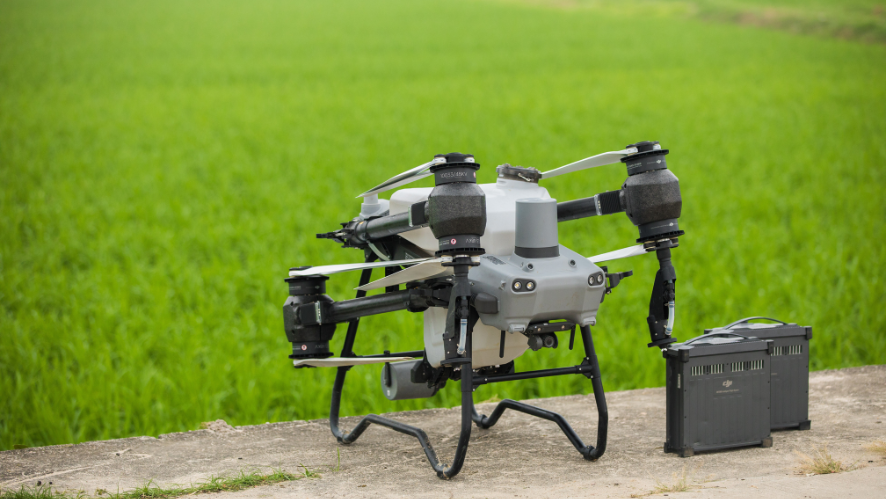
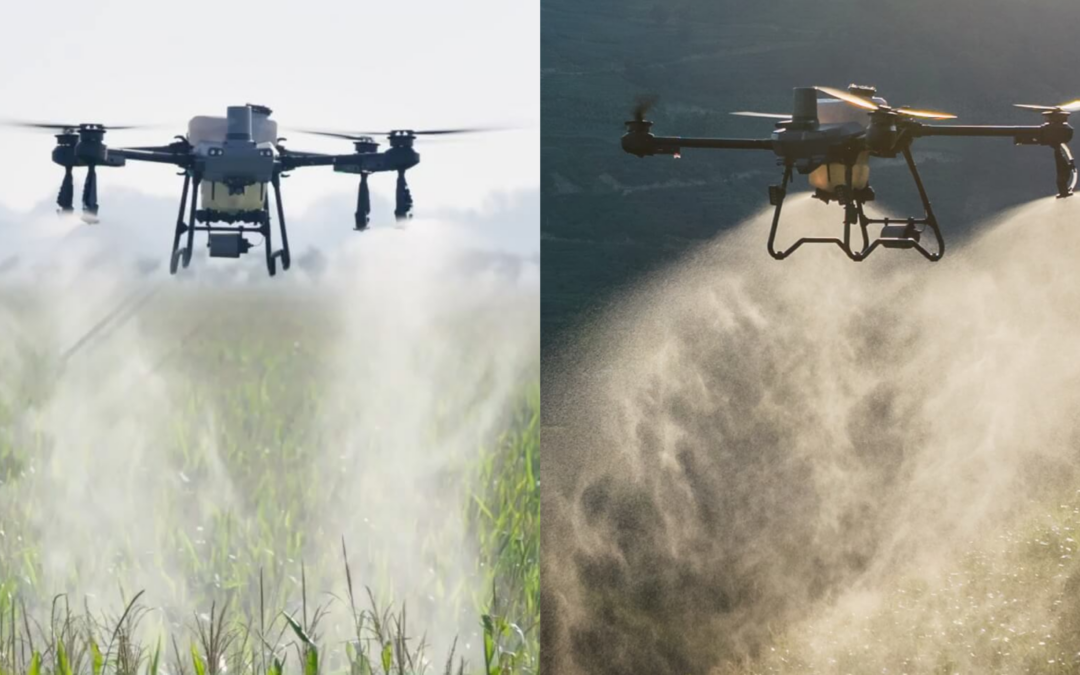
Agricultural technology is advancing at a breakneck pace, redefining what’s possible in terms of precision and efficiency in the field. Recently, the DJI Agras series has expanded with the addition of the Agras T25P (an upgrade to the Agras T25) and the Agras T100.
The truth is that not all agricultural projects require a high-capacity drone like the DJI Agras T100; sometimes it makes more sense to use a more agile and compact drone like the DJI Agras T25P. That’s why HPDRONES will explore the differences between the DJI Agras T25 and the new DJI Agras T25P in terms of technology, safety, and productivity, to help you choose the best investment for your business.
Design and Portability
Both drones feature a foldable design and a lightweight body, making them ideal for operation by a single person.
- Agras T25: a pioneering drone in terms of compact design.
- Agras T25P: maintains portability while incorporating structural refinements to support additional sensor systems, remaining agile for takeoffs on uneven terrain.
Dispersion System
One of the major differences lies here.
- Agras T25: supports up to 25 kg and has a maximum discharge rate of up to 72 kg/min.
- Agras T25P: supports up to 25 kg and has an impressive maximum discharge rate of up to 190 kg/min. Additionally, it is equipped with the new Spreading System 4.0, a real-time weighing system with automatic calibration.
If your operation focuses on granular application, the T25P has the advantage.
Spraying System
In terms of liquid capacity, both models can hold up to 20 liters in the tank. Both the T25 and the T25P allow for the installation of 4 centrifugal spray nozzles, which increases the flow rate from 16 L/min to 24 L/min.
The main difference between the two is that the T25P features electronic stabilization algorithms in the FPV camera, which helps the operator monitor the spraying with a much more stable image, even during rapid maneuvers.
Safety and Sensors
The evolution between the two drones is significant in terms of artificial intelligence and accident prevention.
- Agras T25: uses front and rear phased-array radars and binocular vision to detect obstacles.
- Agras T25P: comes equipped with the new Safety System 3.0, which includes updated millimeter-wave radars and a Tri-Vision system, increasing computing power by 10x. This results in a much greater ability to detect less noticeable and thin obstacles such as high-voltage cables, and smoother terrain tracking on slopes up to 50°.
Transmission and Connection
- Agras T25: uses the O3 system, which has a range of up to 2 km under ideal conditions.
- Agras T25P: features optimized signal stability for areas with obstructions. It is compatible with the DJI Relay (signal repeater), ensuring you never lose contact with the drone in valleys or denser orchards.
Comparative Summary
| Features | Agras T25 | Agras T25P |
| Design | Foldable and Compact | More built-in sensors |
| Dispersion Load | 25 kg | 25 kg |
| Dispersion Flow | 72 kg/min | 190 kg/min |
| Spray Load | 20 L | 20 L |
| Spray Flow | 16 a 24 L/min | 16 a 24 L/min / Monitoring with higher image quality |
| Security System | Dual Radars and Binocular Vision | Security System 3.0 and Tri-Vision |
| Field Mapping | Yes | Yes, but faster with the new processor |
Which one is best suited for your business?
The choice depends on the complexity of your terrain and the primary application.
If you’re looking for an extremely reliable, compact, and efficient drone for spraying on flat or moderately sloped areas, offering excellent value for money, choose the: DJI Agras T25.
If spreading granules (fertilizers/seeds) is a priority, or if you operate in areas with many obstacles and steep slopes and protection is crucial for your investment, choose the: DJI Agras T25P.
If you feel you need personalized support before making a decision, don’t hesitate to contact the HPDRONES technical team for a demonstration or a detailed quote.
Between the cutting-edge technology of the T25P and the unbeatable value of the T25, what’s the leap you need to take to boost your agricultural productivity?